Showing posts with label Michael Dubruiel. Show all posts

Sunday, September 20, 2026

Feast of St. Matthew - September 21

        The feast of St. Matthew is September 21.


Matthew 26-28: Jesus' life-giving death by Amy Welborn offers a close look at the passion, death, and resurrection of Jesus Christ in Matthew's Gospel. 


It is a part of Loyola Press' Six Weeks With the Bible series, which provides individuals or groups plans for concise but thorough 90-minute sessions to learn about and discuss the pertinent Scriptural passages.  General guides for how to effectively lead an adult education session are also included.  The series is available in paperback and also in Kindle version


"amy welborn"

Amy Welborn's Substack: Confession and Penance

   Amy Welborn has a Substack called Trust Walk, with a focus on experiences of Catholics after Vatican II. Here's a post on Confession and penance. 


"amy welborn"


What I particularly like about Morrow’s take is her gently-worded, yet pointed conclusions about church leaders “confidence” in both the impact of these changes and the desire of Catholics to be free of obligation and choose-their-own penitential practice. To get a sense of this, read the 1966 document.

The specifics? All of the previous fasting and abstaining was abolished as obligatory except for Fridays during Lent and Ash Wednesday. Previously, of course abstaining from meat had been obligatory on every Friday. Every day of Lent had been a fasting day (one regular meal, two collations, only one of the meals could contain meat). Ember Days and Vigils to certain feasts had also been days of fasting.

Fridays were still treated as a day of penitential practice, but as the document exhorts, individual Catholics were now free to fashion their own penance, in tune with their own individual spiritual growth.


MORE

Friday, September 18, 2026

Amy Welborn Substack: Communion in the Hand

   Amy Welborn's Substack called Trust Walk tracks experiences of Catholics in the post-Vatican II era. Here's a post on Communion in the hand. 


"amy welborn"


So…my memories?

Scant. Which is interesting, because it seem to show that even though we were not receiving Communion in the hand before 1977 in Knoxville, Tennessee, it did not feel like a big deal. It doesn’t stick in my memory as such, at least.

I was a senior in a Catholic high school in the south, and I don’t remember when this was - probably the fall - that the priest/principal gave us instructions on receiving in the hand in our religion class.

He stood at the front of the classroom - a very large fellow - and quoted St. Cyril, demonstrating how to make “the left hand a throne for the right, which receives the King.”


MORE

Thursday, September 17, 2026

The Great Adventure Kids Catholic Bible Chronicles by Amy Welborn

          A collection of Bible stories to excite young readers about the great adventure God has in store for those who follow him.


The Great Adventure Kids Catholic Bible Chronicles by Amy Welborn is designed to help children ages 8-12 understand the greatest story of all time. It features 70 stories carefully chosen to capture the story of salvation history in its entirety from Adam and Eve to Christ and the Apostles.


Written by a gifted children’s storyteller, the Catholic Bible Chronicles makes the stories of Biblical heroes like Abraham, Moses, David, and the Blessed Virgin Mary come alive. Each story features an illustration that helps readers imagine what it would have been like to be present as biblical history unfolded. 


This 320-page book reads like a novel and incorporates the 12 color-coded time periods of The Bible TimelineⓇlearning system throughout to make it easier for children to grasp the chapters of Biblical history.


With a focus on how the stories of God’s family members intersect across time, Catholic Bible Chronicles will allow young people to see for themselves that God has a plan for us all.

Wednesday, September 16, 2026

Catholic Homeschool Materials


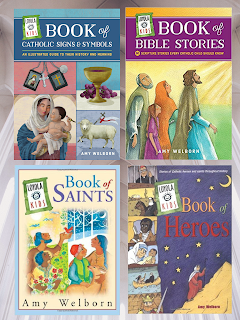
Use the Loyola Kids Book of Bible Stories in your homeschool this year.

Experience the Bible as a family!

Written by popular Catholic children's author Amy Welborn, this beautifully illustrated collection of warm and engaging Bible stories for children and their families is arranged in a uniquely Catholic way—based on the liturgical year and the order in which they are proclaimed during Mass. Divided into five sections—Advent, Christmas, Ordinary Time, Lent, and Easter—each section is subdivided into Old and New Testament stories.
From the Creation to St. Paul, the charming illustrations in Loyola Kids Book of Bible Stories and Welborn's friendly writing style turn reading the Bible into an experience that draws families closer together and deeper into the heart of the Church.

Tuesday, September 15, 2026

High School Catholic Religion Resources


isn't apologetics, but a guide to discipleship. How can a teen live joyfully and faithfully? What does it mean to do that? What's right and what's wrong? What's my life for?
  • Who Am I
  • Sure, I Want to Be a Good Person, But...How?
  • What's Jesus Got To Do With It?
  • It Was Only a Little Lie. So?
  • I've Got All The Time In The World...Don't I?
  • Love Who? Everyone? Really?
  • It's My Body. All Mine.
  • How Far Can I Go?
  • Whose Life Is Worth Living?
  • It's A Big World With Too Many Problems.  Can't I Just Live My Life?
  • "Be Not Afraid"
 
"amy welborn"

Monday, September 14, 2026

Our Lady of Sorrows - September 15


From B16 in 2011:

Marian devotion focuses on contemplation of the relationship between the Mother and her divine Son. In their prayers and sufferings, in their thanksgiving and joy, the faithful have constantly discovered new dimensions and qualities which this mystery can help to disclose for us, for example when the image of the Immaculate Heart of Mary is seen as a symbol of her deep and unreserved loving unity with Christ.

It is not self-realization, the desire for self-possession and self-formation, that truly enables people to flourish, according to the model that modern life so often proposes to us, which easily turns into a sophisticated form of selfishness. Rather it is an attitude of self-giving, self-emptying, directed towards the heart of Mary and hence towards the heart of Christ and towards our neighbour: this is what enables us to find ourselves.

In other words, in other paradoxical words:

If this world of Passionately-Chasing-Your-Dreams-to-Set-the-World-on-Fire is not your life, if your life, in comparison, seems too quiet and humble and maybe even painful to boast about, if, on a daily basis, you put aside your own desires so you can serve others, and the current flow makes you wonder about that, prompts you to wonder sometimes if you’re actually living an “authentic” “vibrant” “fulfilling” “faith-filled” life? If you are, perhaps, putting your real, important, significant life “on hold?” If circumstances have challenged and upended your achievement-oriented goals and you’re having to spend time shifting gears, serving others and making sacrifices for them and the greater good instead of chasing your own dreams? And if this time of adjustment and sacrifice seems to be defined, most of all by words like confusion, grief, frustration and loss?

Well, hang on – and it’s not me saying this. It’s the Catholic spiritual tradition, from Jesus himself on. Be assured:

In your sacrifice and, when it comes, in your sorrow, you are close – very close – to the heart of Christ. 

And so in that, peace. 

From the Loyola Kids Book of Catholic Signs and Symbols by Amy Welborn

Sunday, September 13, 2026

Exaltation of the Holy Cross - September 14

  Pope Leo at the Angelus in 2025:

The Lord welcomes him, listens to him, and eventually reveals to him that the Son of Man must be lifted up, “so that whoever believes in him may have eternal life” (Jn 3:15), adding: “For God so loved the world that he gave his only Son, so that everyone who believes in him might not perish but might have eternal life” (v. 16). Nicodemus, who perhaps does not fully comprehend the meaning of these words in the moment, will certainly do so when he helps to bury the Savior’s body after the crucifixion (cf. Jn 19:39). It is then that he will understand that God, in order to redeem humanity, became man and died on the cross. 

Jesus speaks of this to Nicodemus, recalling an episode in the Old Testament, when the Israelites were bitten by venomous snakes in the desert and were healed by looking upon the bronze serpent that Moses had fashioned and mounted on a pole in obedience to God’s command (cf. Num 21:4-9).

God saves us by showing himself to us, offering himself as our companion, teacher, doctor, friend, to the point of becoming bread broken for us in the Eucharist. In order to accomplish this task, he used one of the cruelest instruments that human beings have ever invented: the cross.


Of course, this feast is related to St. Helena:

St. Helena is in the Loyola Kids’ Book of Saints. by Amy Welborn. The first page here…her section is “Saints are people who are strong leaders.”

"amy welborn"


From the Loyola Kids Book of Catholic Signs and Symbols. I have, of course, many cross and crucifixion-related entries. One, in the section about symbols related to Jesus’ passion, one in the section about symbols you’d see in church, another in the section about those you’d have in your home. Remember the structure: Left-hand page has the illustration and a simpler explanation. Right-side page goes into more depth for older children.


Saturday, September 12, 2026

High School Catholic Religion Resources

        This series of apologetics works for Catholic teens and young adults encompasses the diverse questions Catholic teens have in their own hearts about faith, and those they are asked by others.


Prove It: God by Amy Welborn

 I Don't Believe in God Because....

  • ...No One Can Prove He Exists
  • ...Science Shows That the Universe Exists Without a God
  • ...People Could Have Just Made the Stuff in the Bible up
  • ...It’s So Difficult to Find Him
  • ...People Have So Many Different Ideas About Him
  • ...There are So Many Hypocrites in Churches
  • ...People Do Such Horrible Things in the Name of Religion
  • ...It’s What I Believe and I Don’t Need Anyone Else to Tell Me What to Believe!
  • ...I Want to Be Free to Be Myself
  • ...I Don’t Need Him
  • ...Innocent People Suffer


"amy welborn"


Friday, September 11, 2026

Holy Name of Mary - September 12

      Today - September 12 - is the feast of the Most Holy Name of Mary


Mary and the Christian Life is a simple book introducing the reader to Mary: what Scripture reveals about her, what Tradition teaches, and how all of that relates to our lives as disciples of Jesus. Learn about Mary's life, about prayers and devotions inspired by her, and even about plants and interesting places associated with Jesus' mother.


"amy welborn"


Thursday, September 10, 2026

Catholic Homeschool Religion Books

      amy welborn


amy welborn


Holy Church celebrates the saving work of Christ on prescribed days in the course of the year with sacred remembrance. Each week, on the day called the Lord's Day, she commemorates the Resurrection of the Lord, which she also celebrates once a year in the great Paschal Solemnity, together with his blessed Passion. In fact, throughout the course of the year the Church unfolds the entire mystery of Christ and observes the birthdays of the Saints. (no. 1)

The liturgical year consists of a seasonal cycle and a sanctoral cycle, called the Proper of Time and the Proper of Saints, respectively. Both are organized and published in a liturgical calendar, which is also enriched by observances proper to local Churches, whether national, diocesan, parish-level, or religious community. The Paschal Mystery of Jesus Christ—his suffering, death, and resurrection—is continuously proclaimed and renewed through celebrating the events of his life and in the feasts of the Blessed Virgin Mary and the saints.


Wednesday, September 9, 2026

Homeschool History

      amy welborn


amy welborn


While enough has been said above to show how ready he was to interfere in the Church's domain, it does not appear that this propensity arose from motives discreditable to his religious character. It would be absurd to pretend that Charlemagne was a consistent lifelong hypocrite; if he was not, then his keen practical interest in all that pertained to the services of the Church, his participation even in the chanting of the choir (though, as his biographer says, "in a subdued voice") his fastidious attention to questions of rites and ceremonies (Monachus Sangallensis), go to show, like many other traits related of him, that his strong rough nature was really impregnated with zeal, however mistaken at times, for the earthly glory of God. He sought to elevate and perfect the clergy, both monastic and secular, the latter through the enforcement of the Vita Canonica or common life. Tithes were strictly enforced for the support of the clergy and the dignity of public worship. Ecclesiastical immunities were recognized and protected, the bishops held to frequent visitation of their dioceses, a regular religious instruction of the people provided for, and in the vernacular tongue. Through Alcuin he caused corrected copies of the Scripture to be placed in the churches, and earned great credit for his improvement of the much depraved text of the Latin Vulgate. Education, for aspirants to the priesthood at least, was furthered by the royal order of 787 to all bishops and abbots to keep open in their cathedrals and monasteries schools for the study of the seven liberal arts and the interpretation of Scriptures. He did much also to improve ecclesiastical music, and founded schools of church-song at Metz, Soissons, and St. Gall. For the contemporary development of Christian civilization through Alcuin, Einhard, and other scholars, Italian and Irish, and for the king's personal attainments in literature, see CAROLINGIAN SCHOOLS; ALCUIN; EINHARD. He spoke Latin well, and loved to listen to the reading of St. Augustine, especially "The City of God". He understood Greek, but was especially devoted to his Frankish (Old-German) mother tongue; its terms for the months and the various winds are owing to him. He attempted also to produce a German grammar, and Einhard tells us that he caused the ancient folksongs and hero-tales (barbara atque antiquissima carmina) to be collected; unfortunately this collection ceased to be appreciated and was lost at a later date.

From boyhood Charles had evinced strong domestic affections. Judged, perhaps, by the more perfectly developed Christian standards of a later day, his matrimonial relations were far from blameless; but it would be unfair to criticize by any such ethical rules the obscurely transmitted accounts of his domestic life which have come down to us. What is certain (and more pleasant to contemplate) is the picture, which his contemporaries have left us, of the delight he found in being with his children, joining in their sports, particularly in his own favourite recreation of swimming, and finding his relaxation in the society of his sons and daughters; the latter he refused to give in marriage, unfortunately for their moral character. He died in his seventy-second year, after forty-seven years of reign, and was buried in the octagonal Byzantine-Romanesque church at Aachen, built by him and decorated with marble columns from Rome and Ravenna. In the year 1000 Otto III opened the imperial tomb and found (it is said) the great emperor as he had been buried, sitting on a marble throne, robed and crowned as in life, the book of the Gospels open on his knees. In some parts of the empire popular affection placed him among the saints. For political purposes and to please Frederick Barbarossa he was canonized (1165) by the antipope Paschal III, but this act was never ratified by insertion of his feast in the Roman Breviary or by the Universal Church; his cultus, however, was permitted at Aachen [Acta SS., 28 Jan., 3d ed., II, 490-93, 303-7, 769; his office is in Canisius, "Antiq. Lect.", III (2)]. According to his friend and biographer, Einhard, Charles was of imposing stature, to which his bright eyes and long, flowing hair added more dignity. His neck was rather short, and his belly prominent, but the symmetry of his other members concealed these defects. His clear voice was not so sonorous as his gigantic frame would suggest. Except on his visits to Rome he wore the national dress of his Frankish people, linen shirt and drawers, a tunic held by a silken cord, and leggings; his thighs were wound round with thongs of leather; his feet were covered with laced shoes. He had good health to his sixty-eighth year, when fevers set in, and he began to limp with one foot. He was his own physician, we are told, and much disliked his medical advisers who wished him to eat boiled meat instead of roast. No contemporary portrait of him has been preserved. A statuette in the Musée Carnavalet at Paris is said to be very ancient.


Monday, September 7, 2026

Nativity of Mary - September 8

         Mary and the Christian Life by Amy Welborn  was published by Word Among Press in 2008


Review from Sarah Reinhard : 

In less than 150 pages, Welborn shares relevant history, devotions, and thoughts on the Blessed Virgin. Her language is so accessible, so real, that I almost feel like she was sitting across the table from me as I drank coffee and devoured the book.

If you're unsure about devotion to Mary and why it's important, this is a great book to introduce you to it without hitting you over the head with it. If you're grounded in your Marian approach, pick up this book and find yourself reminded of the beauty of the simple, of the richness of the history, and of the thoughts of great minds before us about Mary.


"amy welborn"

Sunday, September 6, 2026

St. Peter Claver - September 9

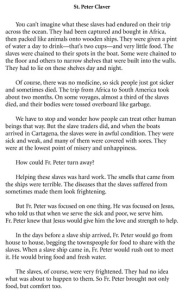
        He's in The Loyola Kids’ Book of Saints by Amy Welborn

An excerpt:
Peter claver
He's under "Saints are people who travel far from home."
I. Saints are People Who Love Children
St. Nicholas,St. John Bosco, St. Elizabeth Ann Seton, Blessed Gianna Beretta Molla
amy welbornSaints Are People Who Love Their Families
St. Monica,St. Cyril and St. Methodius, St. Therese of Lisieux,Blessed Frederic Ozanam,
Saints Are People Who Surprise OthersSt. Simeon Stylites,St. Celestine V,St. Joan of Arc,St. Catherine of Siena
Saints Are People Who Create
St. Hildegard of Bingen,Blessed Fra Angelico,St. John of the Cross,Blessed Miguel Pro
Saints Are People Who Teach Us New Ways to Pray
St. Benedict,St. Dominic de Guzman,St. Teresa of Avila,St. Louis de Monfort
Saints Are People Who See Beyond the Everyday
St. Juan Diego, St. Frances of Rome, St. Bernadette Soubirous, Blessed Padre Pio
Saints Are People Who Travel From Home
St. Boniface, St. Peter Claver, St. Francis Xavier, St. Francis Solano, St. Francis Xavier Cabrini

Saturday, September 5, 2026

Homeschooling Resources

      amy welborn


amy welborn
Use the Loyola Kids Book of Heroes by Amy Welborn in your homeschool this year. 

About Cardinal Nguyen Van Thuan:

The creative fidelity found in the martyrs and in those who, like Father Peter, fled Vietnam to pursue their vocation, permeated Archbishop Thuan’s actions during his imprisonment. He used his limited resources creatively in order to fulfill his duties as shepherd to the faithful when he was in prison. When he could not physically be present to his people, he solicited the help of a young boy to bring him old calendars. He wrote simple, sincere messages of hope on the calendars and had the young boy copy and distribute them among the faithful. His profound letters to the Catholic community strengthened them in their faith and helped them to persevere. The words, which resonated in the people’s hearts, reminded them that their beloved archbishop, though not physically present, was present with them through prayer.
Archbishop Thuan, manifesting innovative fidelity, also used his scanty means to celebrate Mass in prison. He knew that celebrating Mass was his most important duty, but he had no church, no altar, and no tabernacle. How, then, could he fulfill his duty as bishop? He turned the concentration camp into a cathedral and the palm of his hand into an altar. He turned his shirt pocket into a tabernacle and turned the darkness of the sleeping quarters into a dwelling place for Light Himself. Because of his ingenuity, many prisoners regained the fervor of their faith. The prisoners were reminded to embrace suffering and to use their current circumstances to grow in faith. His example not only embodies the proactive faith of past and present Vietnamese Catholics but also teaches all Christians that faith entails an active surrender to the Lord. It means seeking the best way to proclaim Christ’s love in every moment, every circumstance, and every action.

Friday, September 4, 2026

Saint Teresa of Calcutta - September 5

   v

         Most of the entry I wrote on Mother Teresa (September 5 memorial)  for The Loyola Kids’  Book of Heroes is on the Loyola site, here. 

    When we think about the difference that love can make, many people very often think of one
    amy welborn
    person: Blessed Mother Teresa of Calcutta. A tiny woman, just under five feet tall, with no tools except prayer, love, and the unique qualities God had given her, Mother Teresa is probably the most powerful symbol of the virtue of charity for people today.
    Mother Teresa wasn’t, of course, born with that name. Her parents named her Agnes—or Gonxha in her own language—when she was born to them in Albania, a country north of Greece.
    Agnes was one of four children. Her childhood was a busy, ordinary one. Although Agnes was very interested in missionary work around the world, as a child she didn’t really think about becoming a nun; but when she turned 18, she felt that God was beginning to tug at her heart, to call her, asking her to follow him.
    Now Agnes, like all of us, had a choice. She could have ignored the tug on her heart. She could have filled her life up with other things so maybe she wouldn’t hear God’s call. But of course, she didn’t do that. She listened and followed, joining a religious order called the Sisters of Loreto, who were based in Dublin, Ireland.


    The Loyola Kids Book of Heroes by Amy Welborn


     More saints' lives, organized according to the virtues they expressed through their lives.

    I. Faith
    1. Introduction: Jesus is Born
    2. John the Baptist: A Hero Prepares the Way
    3. Early Christian Martyrs: Heroes are Faithful Friends
    4. Medieval Mystery Plays: Heroes Make the Bible Come to Life
    5. St. Albert the Great: Heroes Study God’s Creation
    6. Sister Blandina Segale: Heroes Work in Faith
    II. Hope
    1. Introduction: Jesus Teaches
    2. Pentecost: Heroes on Fire with Hope
    3. Paul: A Hero Changes and Finds Hope
    4. St. Patrick and St. Columba: Heroes Bring Hope into Darkness
    5. St. Jane de Chantal: Heroes Hope through Loss
    6. St. Mary Faustina Kowalska: A Hero Finds Hope in Mercy
    Charity
    1. Introduction: Jesus Works Miracles
    2. Peter and John: Heroes are Known by their Love
    3. St. Genevieve: A City is Saved by a Hero’s Charity
    4. St. Meinrad and St. Edmund Campion: Heroes love their Enemies
    5. Venerable Pierre Toussaint: A Hero Lives a Life of Charity
    6. Rose Hawthorne Lathrop: A Hero Cares for Those Who Need it Most
    7. Blessed Teresa of Calcutta: A Hero Lives Charity with the Dying
    Temperance
    1. Introduction: Jesus Strikes a Balance
    2. Peter and Cornelius: Heroes Love Their Neighbors
    3. Charlemagne and Alcuin: Heroes Use their Talents for Good
    4. St. Francis: A Hero Appreciates Creation
    5. Venerable Matt Talbot: Heroes Can Let Go
    6. Blessed Pier Giorgio Frassati: A Hero Enjoys the Gift of Life
    Prudence
    1. Introduction: Jesus Gives Us Leaders to Help us Make Good Choices
    2. Paul and Barnabas at Lystra: Heroes See the Good in All Things
    3. St. Jean de Brebeuf: A Hero Respects Others
    4. Catherine Doherty and Jean Vanier: Heroes Bring New Ideas
    5. Venerable Solanus Casey: A Hero Accepts His Life
    6. Blessed John XXIII: A Hero Finds a New Way

Thursday, September 3, 2026

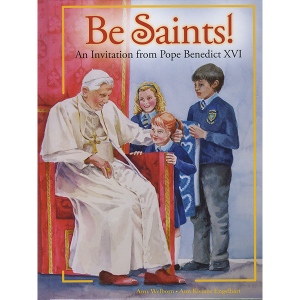
Be Saints by Amy Welborn


Several years ago, Pope Benedict spoke to schoolchildren. Out of it came our book Be Saints!


Watercolors by the wonderful Ann Engelhart.


"amy welborn"


"amy welborn""amy welborn""amy welborn"
"amy welborn"
Ann was interviewed about her work on this book here. 


Be Saints by Amy Welborn

Gregory the Great - September 3


Gregory the Great's feast is today, September 3.

"amy welborn""amy welborn"
More on The Loyola Kids’ Book of Saints
Over 40 saints’ lives,written at a middle-school reading level.
I. Saints are People Who Love Children
St. Nicholas,St. John Bosco, St. Elizabeth Ann Seton, Blessed Gianna Beretta Molla
amy welbornSaints Are People Who Love Their Families
St. Monica,St. Cyril and St. Methodius, St. Therese of Lisieux,Blessed Frederic Ozanam,
Saints Are People Who Surprise OthersSt. Simeon Stylites,St. Celestine V,St. Joan of Arc,St. Catherine of Siena
Saints Are People Who Create
St. Hildegard of Bingen,Blessed Fra Angelico,St. John of the Cross,Blessed Miguel Pro
Saints Are People Who Teach Us New Ways to Pray
St. Benedict,St. Dominic de Guzman,St. Teresa of Avila,St. Louis de Monfort
Saints Are People Who See Beyond the Everyday
St. Juan Diego, St. Frances of Rome, St. Bernadette Soubirous, Blessed Padre Pio
Saints Are People Who Travel From Home
St. Boniface, St. Peter Claver, St. Francis Xavier, St. Francis Solano, St. Francis Xavier Cabrini
Saints Are People Who Are Strong Leaders
St. Helena, St. Leo the Great, St. Wenceslaus, St. John Neumann
Saints Are People Who Tell The Truth
St. Polycarp, St. Thomas Becket, St. Thomas More, Blessed Titus Brandsma
Saints Are People Who Help Us Understand God
St. Augustine of Hippo, St. Jerome, St. Patrick, St. Thomas Aquinas, St. Edith Stein
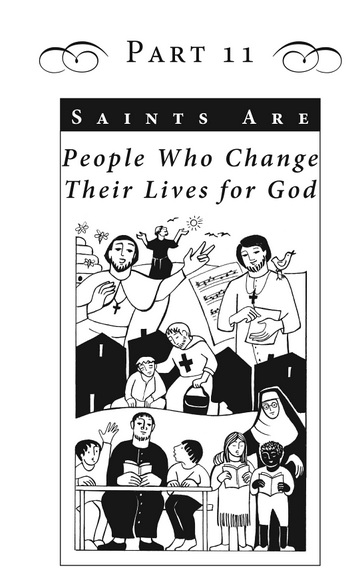
Saints Are People Who Change Their Lives for God
St. Ambrose, St. Gregory the Great, St. Francis of Assisi, St. Ignatius of Loyola, St. Camillus de Lellis, St. Katharine Drexel
Saints Are People Who Are Brave
St. Perpetua and St. Felicity, St. George, St. Margaret Clitherow, St. Isaac Jogues, The Carmelite Nuns of Compiegne, St. Maximilian Kolbe
Saints Are People Who Help the Poor and Sick
St. Elizabeth of Hungary, St. Vincent de Paul, St. Martin de Porres, Blessed Joseph de Veuster
Saints Are People Who Help In Ordinary Ways
St. Christopher, St. Blaise, St. Anthony of Padua, St. Bernard of Montjoux
Saints Are People Who Come From All Over the World
Blessed Kateri Tekakwitha, St. Paul Miki, Blessed Peter To Rot, Blessed Maria Clementine Anuarite Nengapeta