Showing posts with label Amy Welborn. Show all posts

Friday, November 6, 2026

Free Book on Kindle

         Here. Now. A Catholic Guide to the Good Life - free today

 So many questions. So many "answers."

Who am I? What do I want out of life? When did everything get so complicated? Where will I find true happiness? Why do I think that’s even possible? How do I choose what’s right and what’s best in a world with a million different voices trying to get me to listen to – and live by – their answers?

There’s a voice that will always tell you the truth. The voice that belongs to the One who created you. The voice that belongs to the One who loves you the most deeply and who wants nothing but the absolute best for you. The voice that belongs to the One who knows where your personal path to true peace and happiness lies.

Originally published in 2004 by Our Sunday Visitor, this ebook version is published by the author, Amy Welborn


"amy welborn"

Thursday, November 5, 2026

Devotional on Hope

     For the Jubilee of Hope, but useful any time: 

"amy welborn"

Hope: An Anchor for the Soul by Amy Welborn :


In sync with the 2025 Jubilee Year, popular author Amy Welborn takes readers on a 30-day personal pilgrimage of hope. Each day’s devotional reflection is anchored by Scripture, prayerful reminders, encouragement and virtuous actions for grounding readers in Christian hope and equipping them to grow in hope and bring that hope to the world. Perfect for any time of year!


Wednesday, November 4, 2026

First Sunday of Advent: November 29, 2026

     Advent begins November 29, 2026

"amy welborn"


Like the rest of us, families make their way toward Christmas in a world that is already celebrating, if not the coming of Christ, at least the season of parties and gift-giving. How do we focus on Jesus and the Incarnation amid the busy-ness of getting ready for December 25? Author Amy Welborn offers families simple ways to find the gospel message in what is going on all around them, even in preparations that can get hectic at times. These brief but pointed devotions will keep a family centered on what is most important not only at this time of the year, but every day.

Tuesday, November 3, 2026

First Sunday of Advent: November 29, 2026

       Advent begins on November 29, 2026

 From Amy Welborn: 


"amy welborn"


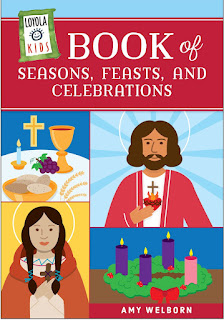
The liturgical year isn't a concept to be taught; it's a celebration to be lived and experienced! Award-winning author Amy Welborn shines a spotlight on our vibrant faith by centering children as active participants in the seasons and feasts of our Catholic calendar. This friendly and accessible sourcebook for children provides an inspiring and multicultural journey through the Church year with Jesus, Mary, and the saints. Along the way, children will learn exciting details about how Catholic holidays are celebrated around the world.

From the Sabbath through Holy Week, from Ordinary Time through the Jewish feasts of our spiritual heritage, Loyola Kids Book of Seasons, Feasts, and Celebrations will enable children and adults to experience faith with curiosity and wonder.

Monday, November 2, 2026

St. Martin de Porres November 3

       St. Martin de Porres is in this book, under "Saints are people who help the poor and sick."  The first page:


amy welborn


The Loyola Kids' Book of Saints by Amy Welborn

 Over 40 saints' lives,written at a middle-school reading level.

  I. Saints are People Who Love Children St. Nicholas,St. John Bosco, St. Elizabeth Ann Seton, Blessed Gianna Beretta Molla

Saints Are People Who Love Their Families St. Monica,St. Cyril and St. Methodius, St. Therese of Lisieux,Blessed Frederic Ozanam,

 Saints Are People Who Surprise OthersSt. Simeon Stylites,St. Celestine V,St. Joan of Arc,St. Catherine of Siena

  Saints Are People Who Create St. Hildegard of Bingen,Blessed Fra Angelico,St. John of the Cross,Blessed Miguel Pro

  Saints Are People Who Teach Us New Ways to Pray St. Benedict,St. Dominic de Guzman,St. Teresa of Avila,St. Louis de Monfort

  Saints Are People Who See Beyond the Everyday St. Juan Diego, St. Frances of Rome, St. Bernadette Soubirous, Blessed Padre Pio

  Saints Are People Who Travel From Home St. Boniface, St. Peter Claver, St. Francis Xavier, St. Francis Solano, St. Francis Xavier Cabrini

  Saints Are People Who Are Strong Leaders St. Helena, St. Leo the Great, St. Wenceslaus, St. John Neumann

  Saints Are People Who Tell The Truth St. Polycarp, St. Thomas Becket, St. Thomas More, Blessed Titus Brandsma

  Saints Are People Who Help Us Understand God St. Augustine of Hippo, St. Jerome, St. Patrick, St. Thomas Aquinas, St. Edith Stein

  Saints Are People Who Change Their Lives for God St. Ambrose, St. Gregory the Great, St. Francis of Assisi, St. Ignatius of Loyola, St. Camillus de Lellis, St. Katharine Drexel

  Saints Are People Who Are Brave St. Perpetua and St. Felicity, St. George, St. Margaret Clitherow, St. Isaac Jogues, The Carmelite Nuns of Compiegne, St. Maximilian Kolbe

  Saints Are People Who Help the Poor and Sick St. Elizabeth of Hungary, St. Vincent de Paul, St. Martin de Porres, Blessed Joseph de Veuster

  Saints Are People Who Help In Ordinary Ways St. Christopher, St. Blaise, St. Anthony of Padua, St. Bernard of Montjoux

  Saints Are People Who Come From All Over the World Blessed Kateri Tekakwitha, St. Paul Miki, Blessed Peter To Rot, Blessed Maria Clementine Anuarite Nengapeta

Sunday, November 1, 2026

All Saints Day for Children


The Loyola Kids' Book of Saints

by Amy Welborn

Amy Welborn


 Over 40 saints' lives,written at a middle-school reading level.

  I. Saints are People Who Love Children St. Nicholas,St. John Bosco, St. Elizabeth Ann Seton, Blessed Gianna Beretta Molla

Saints Are People Who Love Their Families St. Monica,St. Cyril and St. Methodius, St. Therese of Lisieux,Blessed Frederic Ozanam,

 Saints Are People Who Surprise OthersSt. Simeon Stylites,St. Celestine V,St. Joan of Arc,St. Catherine of Siena

  Saints Are People Who Create St. Hildegard of Bingen,Blessed Fra Angelico,St. John of the Cross,Blessed Miguel Pro

  Saints Are People Who Teach Us New Ways to Pray St. Benedict,St. Dominic de Guzman,St. Teresa of Avila,St. Louis de Monfort

  Saints Are People Who See Beyond the Everyday St. Juan Diego, St. Frances of Rome, St. Bernadette Soubirous, Blessed Padre Pio

  Saints Are People Who Travel From Home St. Boniface, St. Peter Claver, St. Francis Xavier, St. Francis Solano, St. Francis Xavier Cabrini

  Saints Are People Who Are Strong Leaders St. Helena, St. Leo the Great, St. Wenceslaus, St. John Neumann

  Saints Are People Who Tell The Truth St. Polycarp, St. Thomas Becket, St. Thomas More, Blessed Titus Brandsma

  Saints Are People Who Help Us Understand God St. Augustine of Hippo, St. Jerome, St. Patrick, St. Thomas Aquinas, St. Edith Stein

  Saints Are People Who Change Their Lives for God St. Ambrose, St. Gregory the Great, St. Francis of Assisi, St. Ignatius of Loyola, St. Camillus de Lellis, St. Katharine Drexel

  Saints Are People Who Are Brave St. Perpetua and St. Felicity, St. George, St. Margaret Clitherow, St. Isaac Jogues, The Carmelite Nuns of Compiegne, St. Maximilian Kolbe

  Saints Are People Who Help the Poor and Sick St. Elizabeth of Hungary, St. Vincent de Paul, St. Martin de Porres, Blessed Joseph de Veuster

  Saints Are People Who Help In Ordinary Ways St. Christopher, St. Blaise, St. Anthony of Padua, St. Bernard of Montjoux

  Saints Are People Who Come From All Over the World Blessed Kateri Tekakwitha, St. Paul Miki, Blessed Peter To Rot, Blessed Maria Clementine Anuarite Nengapeta

All Saints' Day for Kids


        It's coming! Help your children prepare!

    The Loyola Kids Book of Heroes by Amy Welborn
    "amy welborn"


     More saints' lives, organized according to the virtues they expressed through their lives.


    I. Faith

    1. Introduction: Jesus is Born
    2. John the Baptist: A Hero Prepares the Way
    3. Early Christian Martyrs: Heroes are Faithful Friends
    4. Medieval Mystery Plays: Heroes Make the Bible Come to Life
    5. St. Albert the Great: Heroes Study God’s Creation
    6. Sister Blandina Segale: Heroes Work in Faith

    II. Hope

    1. Introduction: Jesus Teaches
    2. Pentecost: Heroes on Fire with Hope
    3. Paul: A Hero Changes and Finds Hope
    4. St. Patrick and St. Columba: Heroes Bring Hope into Darkness
    5. St. Jane de Chantal: Heroes Hope through Loss
    6. St. Mary Faustina Kowalska: A Hero Finds Hope in Mercy

    Charity

    1. Introduction: Jesus Works Miracles
    2. Peter and John: Heroes are Known by their Love
    3. St. Genevieve: A City is Saved by a Hero’s Charity
    4. St. Meinrad and St. Edmund Campion: Heroes love their Enemies
    5. Venerable Pierre Toussaint: A Hero Lives a Life of Charity
    6. Rose Hawthorne Lathrop: A Hero Cares for Those Who Need it Most
    7. Blessed Teresa of Calcutta: A Hero Lives Charity with the Dying

    Temperance

    1. Introduction: Jesus Strikes a Balance
    2. Peter and Cornelius: Heroes Love Their Neighbors
    3. Charlemagne and Alcuin: Heroes Use their Talents for Good
    4. St. Francis: A Hero Appreciates Creation
    5. Venerable Matt Talbot: Heroes Can Let Go
    6. Blessed Pier Giorgio Frassati: A Hero Enjoys the Gift of Life

    Prudence

    1. Introduction: Jesus Gives Us Leaders to Help us Make Good Choices
    2. Paul and Barnabas at Lystra: Heroes See the Good in All Things
    3. St. Jean de Brebeuf: A Hero Respects Others
    4. Catherine Doherty and Jean Vanier: Heroes Bring New Ideas
    5. Venerable Solanus Casey: A Hero Accepts His Life
    6. Blessed John XXIII: A Hero Finds a New Way

Friday, October 30, 2026

Amy Welborn Substack - Religious Education

  Amy Welborn's Substack Trust Walk focuses on the experiences of Catholics after the Second Vatican Council. This post is about religious education during the period:


"amy welborn"


So, my anecdote. This is mostly to remind you of how quickly things changed. You can read other accounts elsewhere, especially from folks who were older and suffered a great deal from the decisions of mostly priests and religious with the mission of forming them in adult faith by treating them like children who need to be taught a lesson and, like good children, accept what they’ve been told. I was younger, born in 1960, never experienced a Traditional Latin Mass (because I wasn’t taken to Mass until I was five years old), went to public schools and sporadic CCD until 1974, when I started at a diocesan Catholic high school in the South.

The freshman religion teacher was very good. We read Dei Verbum – I think I still have the mass-market copy of the Vatican II documents that we all had in those days – and spent the rest of the year on the Old Testament. Miss Olson was young, but fairly old-school in her approach – even as she was earnestly sharing the vision of the Council with us. She did a good job, and the material was solid.

Then sophomore year? 1975? The main text of the fall semester?

Jonathan Livingston Seagull.


MORE

Thursday, October 29, 2026

The Psalms for Children by Amy Welborn

        "amy welborn"


A Child's Book of Psalms by Amy Welborn  is a hardcover introduction to the Psalms.  It includes many of the Psalms themselves, and an introduction - written by me - explaining what the Psalms are and how they have been prayed by Jewish and Christian people over the centuries, and still are today.

(Illustrated selections from 22 of the Bible s best-loved Psalms. Author Amy Welborn explains the history, background, and types of Psalms in an introduction and two supplemental chapters. Includes a map and visual history of the Holy Land from Abraham through Solomon. Author: Amy Welborn Format: 61 pages, Hardcover Publisher: C. D. Stampley Enterprises (September 2007))

Wednesday, October 28, 2026

Bible Study Resources

             From Pope Benedict XVI's General Audience Catecheses on the Apostle Thomas. Image is from a study guide on the talks by Amy Welborn, available as a free download here. 


amy welborn


The Apostle Thomas' case is important to us for at least three reasons:  first, because it comforts us in our insecurity; second, because it shows us that every doubt can lead to an outcome brighter than any uncertainty; and, lastly, because the words that Jesus addressed to him remind us of the true meaning of mature faith and encourage us to persevere, despite the difficulty, along our journey of adhesion to him.

A final point concerning Thomas is preserved for us in the Fourth Gospel, which presents him as a witness of the Risen One in the subsequent event of the miraculous catch in the Sea of Tiberias (cf. Jn 21: 2ff.).

On that occasion, Thomas is even mentioned immediately after Simon Peter: an evident sign of the considerable importance that he enjoyed in the context of the early Christian communities.

Indeed, the Acts and the Gospel of Thomas, both apocryphal works but in any case important for the study of Christian origins, were written in his name.

Lastly, let us remember that an ancient tradition claims that Thomas first evangelized Syria and Persia (mentioned by Origen, according to Eusebius of Caesarea, Ecclesiastical History 3, 1) then went on to Western India (cf. Acts of Thomas 1-2 and 17ff.), from where also he finally reached Southern India.

Let us end our reflection in this missionary perspective, expressing the hope that Thomas' example will never fail to strengthen our faith in Jesus Christ, Our Lord and Our God.

Tuesday, October 27, 2026

Sts. Simon and Jude – October 28

    October 28 is the memorial of Sts. Simon and Jude. 


        From Pope Benedict XVI's General Audience Catecheses on the Apostles Simon and Jude. Image is from a study guide on the talks by Amy Welborn, available as a free download here. 

Today, let us examine two of the Twelve Apostles: Simon the Cananaean and Jude Thaddaeus (not to be confused with Judas Iscariot). Let us look at them together, not only because they are always placed next to each other in the lists of the Twelve (cf. Mt 10: 3, 4; Mk 3: 18; Lk 6: 15; Acts 1: 13), but also because there is very little information about them, apart from the fact that the New Testament Canon preserves one Letter attributed to Jude Thaddaeus.

Simon is given a nickname that varies in the four lists: while Matthew and Mark describe him as a "Cananaean", Luke instead describes him as a "Zealot".

In fact, the two descriptions are equivalent because they mean the same thing: indeed, in Hebrew the verb qanà' means "to be jealous, ardent" and can be said both of God, since he is jealous with regard to his Chosen People (cf. Ex 20: 5), and of men who burn with zeal in serving the one God with unreserved devotion, such as Elijah (cf. I Kgs 19: 10).

Thus, it is highly likely that even if this Simon was not exactly a member of the nationalist movement of Zealots, he was at least marked by passionate attachment to his Jewish identity, hence, for God, his People and divine Law.

If this was the case, Simon was worlds apart from Matthew, who, on the contrary, had an activity behind him as a tax collector that was frowned upon as entirely impure. This shows that Jesus called his disciples and collaborators, without exception, from the most varied social and religious backgrounds.

It was people who interested him, not social classes or labels! And the best thing is that in the group of his followers, despite their differences, they all lived side by side, overcoming imaginable difficulties: indeed, what bound them together was Jesus himself, in whom they all found themselves united with one another.


amy welborn

Monday, October 26, 2026

Should Catholics Celebrate Halloween?

         The Great Christian Feast-Halloween - by Michael Dubruiel


This is one of those thoughts that comes to you in a moment of clarity with such force that you wonder how it could be that everyone just doesn't see the truth of it.

Last night when I made one of my few trips to the door to hand out candy, it just hit me. There I was confronted with a skull painted white on the face of an African American, who was standing there holding open a bag, expecting something from me.

A home invasion? No.

Trick or Treat!

I gladly obliged his request with a handful of candy and he turned and went on his merry way to join the other hordes of beggars that flooded our streets.

I had just fulfilled the mandate of the Gospel of Jesus Christ! I had just welcomed Him in the guise of the hungry, "When I was hungry, you gave me something to eat." Matthew 25!

"When did we see you Lord?"

"Whenever you did it to the least of my brethren, you did it to me."

Is there anytime left in our year when Americans are so blatantly Christian, welcoming the strangers that come to their door? Is there anytime that we reward those who on purpose try to repulse us by their costumes?

Yet the thought that it is better to give than receive dominates this day and truly the day fulfills its purpose of being the eve of All Saints Day! For if we are ever to join the saints we must learn to make everyday Halloween!

So that today when we meet those we might otherwise demonize, we give what we have freely as though we were meeting Christ Himself in the streets (and if we believe the Gospel message we are in fact meeting him)!

I used to joke that strangers could in fact be demons, (this was when the angel rage was in full swing and I use to make the point that yes a stranger might be an angel but who is to say if it is a good one or a bad one--sort of a twist of the Glenda the Good Witch's question to Dorothy in the Wizard of OZ, "Are you a good witch or a bad witch?"), but I would ask you to reflect on Halloween a bit more with me.

If we give to the stranger, indeed we welcome them as Christ. But if we look at the stranger only as someone who has something to give and we judge them based on that we are apt to conclude that all strangers are demons!

For example if we start viewing every middle eastern looking Arab that we do not know personally as a terrorist we are forgoing an opportunity to see them as Christ (who happened to be of middle eastern descent). Abraham was visited by three strangers (one would presume of middle eastern descent) and he fed them--they turned out to be angels and they gave him a blessing! But let's suppose that we in fact do come across some terrorists in our daily activities. What if our interaction with them, seeing them as Christ and giving them whatever we have to give at that moment (even if it is only a smile of acceptance) led them to change their whole way of viewing Americans?

It is sad to think that a day that is the perfect example of what it means to be a Christian has been protested by so many Christians in this country. Do they read the Gospels?

No one is celebrating or worshipping demons on Halloween. The children who dress up in their costumes are playacting and giving the individual behind every door an opportunity to imitate Christ.

It is also sad that many miss the point in the other direction. They overdo it in the name of "everyone else is doing it" and light their houses up as though it is Christmas, rather than encountering the little masked Christs in the darkness the way it is intended to happen and does happen in daily lives. The vacuous nature of their souls demands making a show of their giving. Sadly they have already received their reward--the empty praise of their neighbors and friends.

There have been moves lately among some Catholics to have children dress up as saints-- this may be a fine thing to do on All Saints day but it totally misses the point of Halloween. We will never be saints, nor will we imitate them, until we open the door everyday and welcome the ghouls we encounter as though they are Christ.


dubruiel

Sunday, October 25, 2026

30 Day Devotional

     For the Jubilee of Hope, but useful any time: 

"amy welborn"

Hope: An Anchor for the Soul by Amy Welborn .  Here's a sample:


Therefore, we are not discouraged; rather, although our outer self is wasting away, our inner self is being renewed day by day. 2 Corinthians 4:16

In the midst of the consuming pain of childbirth, struggling to stay focused, a laboring woman re- minds herself-or might be reminded by those supporting her "The baby! At the end of this, you're going to be holding your baby!"
Even if you've never given birth, you've prob- ably experienced something similar: enduring
months of physical therapy or cancer treatment. Sacrificing big chunks of your life in pursuit of a worthy goal. How do we keep going and do so in a fruitful way? We think of what awaits us at the end of our labor and suffering.

The theological virtue of hope is the gift, given to us at our baptisms, that helps us remember what awaits us at the end of the labor and suffer- ing of this life. It's the desire for eternal life above all things—and the trust in Jesus' promises and mercy to guide us there.

The Lord knows that this life is hard. We can be tempted to stew in those difficult moments and forget God's love, forget that we're here because God loves us and so deeply desires us to dwell with him forever. And so, in the midst of the suffering, we're invited to hope: to let God in and allow that hope to grow and renew us.

Pray: Lord, strengthen my hope in you.


Amy Welborn in Living Faith

                                 Amy Welborn is a contributor - five devotions per issue -  to the Living Faith daily devotional .


"amy welborn"


Today, October 25:


....In other words, my sense of “normal” had developed in that bubble, and it made me think: What about my sense of the fundamental purpose and direction of my life? What “greatest commandment” governs my choices? Is that shaped by my conversations with the world—or the conversation with Christ?


MORE: 


 October 10


There is neither Jew nor Greek, there is neither slave nor free person, there is not male and female; for you are all one in Christ Jesus.
Galatians 3:28

More than one year ago, I stood in St. Peter’s Square when white smoke arose, signaling the election of Pope Leo XIV.  What an experience! Folks from all over the world, so different in some ways but all filled with joy, one in Christ.

What’s amazing is that I don’t have to go to Rome to experience that. Every time I’m at Mass, even if there’s only a few other people present in the dimness of 6:30 a.m. in our Cathedral, it’s the same, really.


MORE


September 29:


I witnessed some serious road rage the other day. It was so aggressive that I hung back from traffic, not wanting to be caught in the middle.


A driver honked at the hesitating car in front of him. That driver slammed on his brakes, inched forward, slammed them again, gunned forward into the busy intersection, circled, then raced back in the direction he’d come, engine roaring. What in the world was that for? I wondered. What did that accomplish?


MORE


 June 23:


God’s presence is like that. To the ends of the earth, every moment with the Lord gives me the opportunity to learn something new—even in the grocery store I visit daily or in the company of an old friend.  Even when ever-old, if my eyes and heart are open to the presence of the living God, what he has to reveal will still be ever-new to me.


MORE


 April 23:


I can sometimes allow my understanding of myself, my life and God to stagnate. I assume I get it, that I’ve got the answers for all the good—and bad—questions and challenges. 

But is that really so? Is what I think I know now all there is to know? Might I be more open to the Philip I might meet along the way, ready, as the Ethiopian, to have my eyes opened to something new?


MORE


April 4:

Have you ever hit rock bottom? Have you ever been in a situation of such sadness and darkness that you could not imagine ever—I mean ever—feeling anything close to joy again? That there was simply no way to loosen the chains, to not feel the weight of grief, frustration or helplessness that afflicted you at that moment?

And have you ever made it through? Have you found that with time and grace, light glimmers and the weight that seemed to define your days has lightened?

That glimpse? Take that and blow it up, expand it to eternity and let it surround and then sweep away all the heavy darkness of your entire life—of the world.


MORE


March 23:


To imaginatively place ourselves in a Gospel scene is an ancient spiritual practice. To do so here invites us to first see ourselves in a special place: alone with Jesus.

Now he asks: Who has condemned us?

MORE


March 8:


Once again, Jesus’ disciples seem to be almost clueless. They’re also intimidated: They don’t dare ask Jesus why he’s talking to this woman. Here, they can’t see past the literal meaning of his words about food. This dynamic can be both a concern and a comfort to me.

If the disciples spent day and night with Jesus and still didn’t grasp his meaning or purpose, what hope do I have? On the other hand, if even the disciples were confused, I suppose I shouldn’t feel badly when I am either.


MORE


, February 26:


There are so many ways that the Lord gives us strength. It can come as we open ourselves to his grace and just find ourselves stronger in mind, spirit and body. He can bless us with wisdom that gives us perspective and, therefore, strength.

And, of course, God answers our call and strengthens us through others who share our joys and pain, who laugh and cry with us. They are brothers and sisters with whom we can stay strong and even joyful during the journey serving God’s people.

MORE


February 2:


What a richly layered feast this is. It’s the real and final end of the Christmas season: Until a few years ago, the Christmas tree in St. Peter’s Square stayed up until this feast. It’s a day to remember and celebrate religious women and men. And over the centuries, the tradition has grown of bringing candles from home to church to be blessed on this day. Candles that, before electricity, would have been used throughout the year, not just for a decorative touch but to give light necessary for everyday living. The candles, then blessed, would shed not only natural light, but be a sign of Christ’s presence.

MORE


December 28:


Among all the genres of viral videos out there, one that I find most affecting is one I’d call “Children meeting their newborn siblings for the first time.”

From teens to toddlers, those moments are nothing but joy. Even small children break into happy tears when their tiny swaddled-up brother or sister is gently placed in their arms. What a mysterious, profound bond is family love!


MORE


November 19:


Could it be that part of Jesus’ “love language” is to gently and persistently remind me to never rest comfortably in my own worldview? That God always has more to reveal to me, and that I always have more to learn?


MORE


November 2:


In many of these shrines, small and large, there’s another image too. It’s a photograph. An old woman. A child. A young man in a uniform. A candle flickers nearby.

Don’t forget, they say. You walk by and ask for prayers. Don’t forget to pray for us too.


MORE


 October 11:


A friend is going through a terrible, world-shifting time. Life today looks completely different than it did even six months ago. She’s done what she could, but she really can’t do any more. It’s hard and sad. We do what we can to accompany those in difficult places. But it’s a challenge to offer words that don’t end up sounding like empty platitudes, isn’t it? Or even, if we’re going through our own hard times, reading words like the psalmist’s and believing them.


MORE


, June 6:


A few years ago, I wandered into a little church in Ferrara, Italy, and saw a black and white photo of a woman religious in front of a tomb. This Sr. Veronica of the Blessed Sacrament was a Carmelite mystic who had died in 1964. Her canonization cause (in Italian) is: SuorVeronica.org.

I was struck, first, by the notion of running into a new-to-me saint around the corner. What surprising people and stories might I encounter anywhere if I’m paying attention?


Friday, October 23, 2026

Book about Pope Benedict XVI


From Come Meet Jesus: An Invitation from Pope Benedict XVI by Amy Welborn. 

 Purchase a pdf copy here. 


amy welborn


Why are you here?

 Not just, why are you wherever you happen to be, reading this book on this particular day? But why are you—the individual you are—on this earth? Why do you exist? Why do you not exist? What’s your purpose? What is going to bring you the most joy, peace, and satisfaction in the blip of time you’ve got here with the rest of us before you head on?

 There may be times—huge chunks of time, even years—during which we think we can dismiss that question, or that the answer seems too obvious for comment. Perhaps life keeps us too busy to think about it, or perhaps we purposefully avoid it. But most of us have to face the question at some point, because life has a habit of forcing us to do so. 

Several years ago, I was sitting at the dentist’s office, waiting for a routine appointment. For some reason that day, I was thinking about life’s meaning and faith and such matters and was at a point of throwing up my hands, in a relatively cheerful kind of way, at the complexity of it all. Maybe it didn’t all need to be so complex. Maybe I should stop worrying, be happy, live and let live, and not stress so much about the big questions. Maybe I shouldn’t even worry so much about the spiritual stuff, with all of those hints of “sacrifice.” Life is good. Why not enjoy it?

Then a woman rushed in, announced herself at the reception desk, and was told that her appointment was actually the following week. Frazzled, she breathlessly said, in a torrent of words, “Oh, I’m sorry. I was nine months pregnant, then last week the baby just died. I’m not really thinking straight.” And she rushed out. Like a heavy, damp cloud, the big picture rushed back in, and the questions reasserted themselves again, loudly, like an unexpected late summer storm.


Wednesday, October 21, 2026

October 22 - Pope John Paul II

         You can get John Paul II's Biblical Way of the Cross by Michael Dubruiel and Amy Welborn here.  


In 1991, Pope John Paul II introduced a new Bible-based interpretation of the Stations of the Cross. This devotional guide invites readers to prayerfully walk in solidarity with Jesus on his agonizing way of the cross—from his last torturous moments in the Garden of Gethsemane to his death and burial.

Now with full-color station images from previously unpublished paintings by Michael O'Brien, this booklet creates an ideal resource for individual or group devotional use, particularly during the Lenten season.

"michael Dubruiel"

Tuesday, October 20, 2026

Introduction to Pope Benedict XVI


From Come Meet Jesus: An Invitation from Pope Benedict XVI by Amy Welborn. 

 Purchase a pdf copy here. 


amy welborn


When we think about life’s meaning, it comes to us in (at least) two different ways.

 First, like the philosophers, we consider the general meaning of existence—why things exist, what the shape and nature of reality reveals about meaning, and so on. We also consider, more urgently, the reason for our own personal existence instead of non- existence. Why did that random sperm and egg meet at that particular moment to create me? What if it hadn’t? The fact that even the very beginnings of our existence seem so contingent on so many variables—on whether or not our parents ever met, or whether or not they were feeling romantic at that moment—can stop us in our tracks. If the difference between my existence and non-existence was an extra glass of wine or an argument finally resolved, what meaning can that existence actually have?

 Mixed up with that type of meaning is the question of purpose. I’m here (however that happened) . . . so now what? Happiness, pleasure, satisfaction, sacrifice, accomplishment, contentment . . . is it about that? Or is it about completely forgetting my own needs and pouring out every gram of my soul for others? Is suffering a sure sign that my life is meaningless—or most meaningful? The world gives plenty of answers.

 During his pontificate, Pope Benedict has alluded to these answers many times. Some might assume that a man in his eighties who worked within the confines of the Roman Curia for decades would have little insight into the shape of the contemporary search for meaning, but that is not true. Pope Benedict is a close observer and a careful listener, profoundly interested in how human beings encounter God, not just in general, but in this particular cultural circumstance in which we find ourselves, because curia or not, those are the circumstances in which he lives and ministers as well. Pope Benedict has, indeed, listened to modern men and women. He was a parish priest and a bishop; he hears confessions; as prefect of the CDF, he read the files of troubled clergy for decades; and throughout his whole career, he has interacted generously and open-mindedly with non-believers. He knows the obstacles, the temptations, and the barriers this world throws up, not only to God, but to the possibility of ultimate meaning and transcendence in general.

 He also seems, in a personal way, very familiar with doubt—the question of doubt reappears often in his writings and comprises a large section of the first part of his Introduction to Christianity. But he also knows that this world is not so different than it always has been, despite our tendency to think so. The wheels may spin faster, on cleaner streets, but human beings still yearn, life still confounds, and Jesus still waits for us, ready for us at the moment we decide that we are ready for him.

Sunday, October 18, 2026

Book about Pope Benedict XVI

From Come Meet Jesus: An Invitation from Pope Benedict XVI by Amy Welborn. 

 Purchase a pdf copy here. 


amy welborn


We have met Jesus. We suspect—or even affirm—that he is what he says he is: the Way, the Truth, and the Life. We confront the image of him crucified, and it won’t leave us. We read what he says about being free from burdens, the possibility of eternal life, and God’s care for us when we are lost. We are, as Pope Benedict wrote of St. Peter, “fascinated” by Jesus. Now what? 

The figure of Jesus Christ beckons and intrigues us. We’re drawn to learn more about him, so it makes sense that we turn to the source: the Bible. It does, indeed, make perfect sense to turn to the Scriptures as we seek to know Jesus. In fact, as St. Jerome says, it makes no sense to claim to know Jesus without the Scriptures: “He who is ignorant of the Scriptures is ignorant of Christ.”

 Pope Benedict said in a speech in 2008:

 How can one love, how can one enter into friendship with someone unknown? Knowledge is an incentive to love, and love stimulates knowledge. This is how it is with Christ too. To find love with Christ, to truly find him as the companion of our lives, we must first of all be acquainted with him. Like the two disciples who followed him after hearing the words of John the Baptist and asked him timidly, “Rabbi, where are you staying?” they wanted to know him better. It was Jesus himself, talking to his disciples, who made the distinction: “Who do people say that I am?”—referring to those who knew him from afar, so to speak, by hearsay, and “Who do you say that I am?”—referring to those who knew him personally, having lived with him and having truly penetrated his private life, to the point of witnessing his prayer, his dialogue with the Father. Thus, it is also important for us not to reduce ourselves merely to the superficiality of the many who have heard something about him—that he was an important figure, etc.—but to enter into a personal relationship to know him truly. And this demands knowledge of Scripture, especially of the gospels where the Lord speaks to us.


 But for many of us, finding and getting to know Jesus through the Scriptures is really not as simple as it sounds. We may be intimidated by the prospect of reading the Bible, since we have never really studied it. We may, unfortunately, think of Scripture reading and study as something for Protestants, not Catholics. We may also be working within some particularly modern paradigms of viewing the Bible, paradigms that are of great interest to Pope Benedict and that he addresses frequently in his catechesis. In short are we too studious about the Bible—and not prayerful enough?

Saturday, October 17, 2026

Catholic Story Bible


\
"story of all stories" bible


The Great Adventure Kids Catholic Bible Chronicles  by Amy Welborn  is designed to help children ages 8-12 understand the greatest story of all time. It features 70 stories carefully chosen to capture the story of salvation history in its entirety from Adam and Eve to Christ and the Apostles.


Written by a gifted children’s storyteller, the Catholic Bible Chronicles makes the stories of Biblical heroes like Abraham, Moses, David, and the Blessed Virgin Mary come alive. Each story features an illustration that helps readers imagine what it would have been like to be present as biblical history unfolded. 

This 320-page book reads like a novel and incorporates the 12 color-coded time periods of The Bible TimelineⓇlearning system throughout to make it easier for children to grasp the chapters of Biblical history.

With a focus on how the stories of God’s family members intersect across time, Catholic Bible Chronicles will allow young people to see for themselves that God has a plan for us all.

This collection of Bible stories will excite young readers about the great adventure God has in store for those who love him.

Friday, October 16, 2026

October 17 - Ignatius of Antioch

        An introduction, from Pope Emeritus Benedict XVI:

St Ignatius was Bishop of Antioch, which today is located in Turkey. Here in Antioch, as we know from the Acts of the Apostles, a flourishing Christian community developed. Its first Bishop was the Apostle Peter - or so tradition claims - and it was there that the disciples were "for the first time called Christians" (Acts 11: 26). Eusebius of Caesarea, a fourth-century historian, dedicated an entire chapter of his Church History to the life and literary works of Ignatius (cf. 3: 36).

Eusebius writes: "The Report says that he [Ignatius] was sent from Syria to Rome, and became food for wild beasts on account of his testimony to Christ. And as he made the journey through Asia under the strictest military surveillance" (he called the guards "ten leopards" in his Letter to the Romans, 5: 1), "he fortified the parishes in the various cities where he stopped by homilies and exhortations, and warned them above all to be especially on their guard against the heresies that were then beginning to prevail, and exhorted them to hold fast to the tradition of the Apostles".

ignatius-of-antiochThe first place Ignatius stopped on the way to his martyrdom was the city of Smyrna, where St Polycarp, a disciple of St John, was Bishop. Here, Ignatius wrote four letters, respectively to the Churches of Ephesus, Magnesia, Tralli and Rome. "Having left Smyrna", Eusebius continues, Ignatius reached Troas and "wrote again": two letters to the Churches of Philadelphia and Smyrna, and one to Bishop Polycarp.

Thus, Eusebius completes the list of his letters, which have come down to us from the Church of the first century as a precious treasure. In reading these texts one feels the freshness of the faith of the generation which had still known the Apostles. In these letters, the ardent love of a saint can also be felt.


Amy Welborn's Books